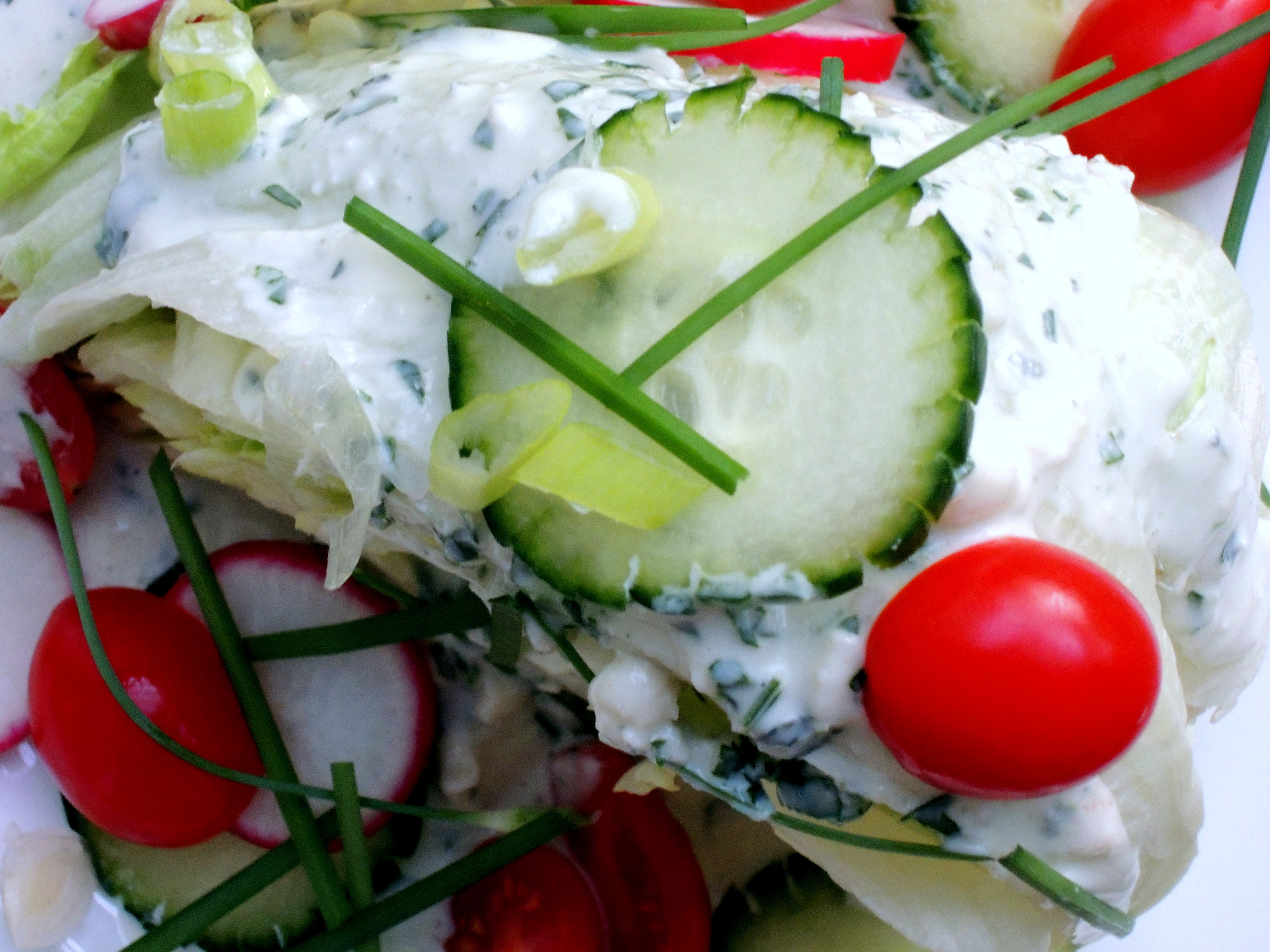
IS THIS A SILLY SALAD?
American children of the 1950s remember a wedge of iceberg lettuce, requiring no culinary exertion beyond minimal knife skills, accompanied by a cluster of bottled commercial salad dressings on the nightly dinner table. Demands on the cook were few, and everyone had their choice of dressing, reducing the possibility of family food fights. The cultivar for crisp head lettuce, characterized by a crunchy head, was introduced in 1894 by the W. Atlee Burpee Company. The first printed version of a recipe for a lettuce wedge salad was offered in Marion Harris Neil’s 1916 cookbook, Salads, Sandwiches and Chafing Dish Recipes. By the 1920s, wedge salads began appearing on restaurant menus.
The nation wide popularity of crisphead lettuce resulted from advances in American transportation. Unlike softer leaf lettuce, which wilted under travel, crisphead could be packed in ice and moved long distances without losing freshness; the arrival of refrigerated railroad cars made distribution even easier. America was shifting away from local food production, and crisphead fit neatly into the country’s increasingly industrialized food system. Its name was changed from crisphead to iceberg.
In the 1930s, when grocery chains proliferated and refrigerators were first installed in American homes, the popularity of iceberg lettuce grew. During the depression money was tight, families may not have shopped as often and they avoided buying produce that perished easily. Lettuce was cheap and iceberg could be kept refrigerated for a week or more. Its fiber and high water content made people feel full. By the time Steve Henson was selling Hidden Valley Ranch salad dressing packets in the mid 1950s, Americans were eating 14 pounds per capita of lettuce every year, up from just over 4 pounds in 1919. Blue cheese crumbles and bacon bits on wedge salads became stylish.
In the 1970s wedge salads declined in popularity as Americans had greater exposure to greens in European and other world cultures and growers offered a wider range of lettuces. Environmentalists criticized iceberg production; grown in massive monocultures, iceberg agriculture damaged soil and required chemicals to support a robust harvest. Iceberg heads are 96% water; the crop needed extensive irrigation, often from imperiled water sources, and constant refrigeration after harvest. Moreover, epicures argued that iceberg was the least flavorful lettuce available. Blanketed with fatty dressings, iceberg won the title of America’s least nutritious and most unhealthy salad. Some commented that there were more calories and fat in an iceberg wedge salad than in a Big Mac. Nick Kindlesperger, writing for the Chicago Tribune, labeled the iceberg wedge a “silly salad.”
Iceberg lettuce wedge salads were saved from the dustbins of food history when they found a new home in steakhouse chains coast to coast. Served cold and crunchy with a creamy dressing, Americans enjoyed the contrast in texture and found them a perfect precursor to a hot, juicy steak. Fine dining they may not have been, but steakhouse patrons demanded them. And iceberg lettuce also was used in other salads (see the Columbia 1905 salad or the corned beef salad with Thousand Island dressing and rye croutons), not to mention as shredded toppings for sandwiches and tacos, or as lettuce cups for Asian minced duck or squab. For more emulsions that can be applied to a wedge of iceberg lettuce, see salad dressings under condiments on this site.