
WILLIAM HENRY HARRISON (MARCH 4 TO APRIL 4, 1841.) portrait by Rembrandt Peale
As white settlement moved westward, the gulf between the wealthy, slave owning gentlemen farmers on the East Coast and the hardscrabble, immigrant family farmers scratching out a living on the frontier widened. In this context, food came to represent the divide. Westerners eschewed the French chefs, wines and fancy foods of elite plantations for the humble, simply prepared beef, corn and pork dishes of the new settlements. Easterners were equally appalled at the plain food and poor manners of the Western hoi palloi. Floating down the Mississippi River on a steamboat in the early 1830s, English novelist Frances Trollope complained of the “total want of all the usual courtesies of the table, the voracious rapidity with which the viands were seized and devoured … and the still more frightful manner of cleaning the teeth afterwards with a pocket knife.”
The incumbent in the 1840 presidential election was Democrat Martin Van Buren, whose first term in office was imperiled by a serious financial collapse. The Whig party chose Ohio congressman William Henry Harrison to oppose him. He ran as a man of the people from the rural West against the elitist, bon vivant Eastern incumbent. Harrison claimed to have lived in a log cabin, dined on hog and hominy and imbibed hard cider just like “real folks.” Van Buren, he charged, dined on turtle soup, duck with fancy sauces, pâtés and foie gras, and frilly desserts. And he drank (gasp!) champagne.
Both claims were pure political malarky or, in contemporary internet parlance, disinformation. Van Buren was not the first president to enjoy French cuisine; many of his predecessors, including the populist Andrew Jackson, did so as well. And Harrison was not raised in a log cabin; he was the educated son of Benjamin Harrison V, a founding father and signer of the Declaration of Independence. His wealthy, distinguished, slave holding family owned Berkeley Plantation, an opulent estate on the James River in Virginia. He was made secretary of the Northwest Territory in 1798 and governor of the Indiana Territory in 1801. His Ohio mansion, hardly a log cabin, sat amid verdant, productive farm fields that would have seemed familiar to gentlemen farmers like Washington and Jefferson. Some suggested Harrison was nominated simply because he looked like Andrew Jackson:


Andrew Jackson at the Battle of New Orleans by Charles Severin and William Henry Harrison on Horse from a campaign poster
Harrison gained status as an Indian fighter when, as Indiana governor, he negotiated multiple treaties with Native American tribes in which millions of acres of tribal land were exchanged for very little money. When the tribes refused to accept the agreements or attacked encroaching white settlements, he responded with military force and seized the lands. Conflict with Native Americans peaked in 1811 at the Battle of Tippecanoe when Shawnee Chief Tecumseh created a confederation of Indian nations to fight against the government’s incursions. As the native army assembled at the confluence of the Tippecanoe and Wabash Rivers they were met and defeated by an offensive force of 1,000 men led by Harrison.
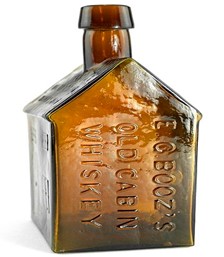
Jackson’s 1832 presidential campaign accustomed the public to politics as entertainment and in 1840 Harrison ran a raucous campaign with huge rallies. Some supporters rolled logs from town to town and others pushed a ten foot, paper and tin ball emblazoned with pro-Harrison slogans for hundreds of miles. The campaign served potential voters whiskey (poured from log cabin-shaped bottles supplied by the Philadelphia distillery E.C. Booz), hard cider and literally tons of meat and pies. The burgoo recipe that follows is typical of the dishes served because it could easily be stretched to feed more mouths. “Keep the ball rolling” and “booze” (an old Dutch word for liquor appropriated by the distiller) became part of the American vernacular.
Harrison’s reputation as a military hero and unabashed supporter of westward expansion grew and fueled his run for president. Despite being widely attacked for being too old to run, he was victorious. Old Tippecanoe gave the longest inauguration speech on record, two hours, out of doors and wearing neither a coat nor a hat. He fell ill shortly thereafter and died 31 days after his inauguration, serving the shortest term on record (he was Commander in chief for 30 days, 12 hours and 30 minutes). In addition to his mistreatment of Native Americans, he is remembered for his questionable campaign tactics.
In his book A Rich and Fertile Land: A History of Food in America, Bruce Kraig writes that “Possibly for the first time, food became a marker of social class, a cultural symbol that has been used by politicians and their handlers ever since. When American politicians hold pancake breakfasts or dutifully eat corn dogs at state fairs, they are following the tradition established by William Henry Harrison, the man who dominated the vote and won the presidency on the promise that he ate and drank like real Americans.”


“HARD CIDER” CANDIDATE